
 Português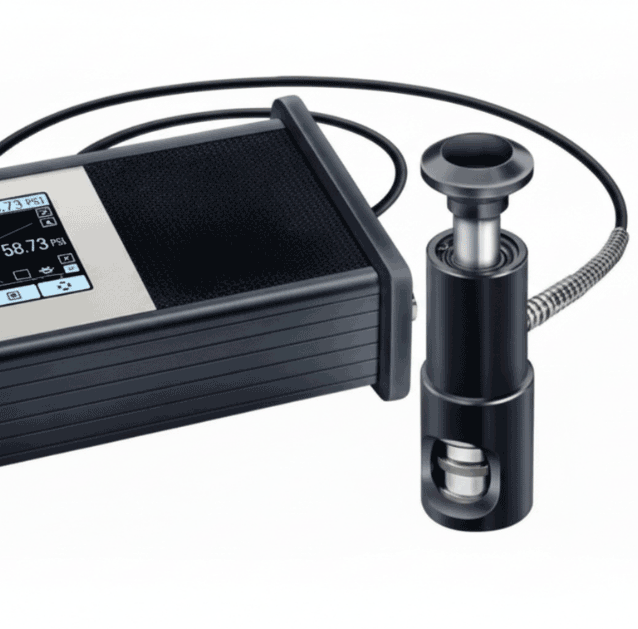
Pull-off Test: The Fire Test for Adhesion in Anti-Corrosion Paints
Corrosion is one of the main causes of degradation of metallic structures, with a direct impact on the safety and operational costs in various industrial sectors. Among the main combat strategies is the use of anti-corrosion paints. However, a paint with an excellent formulation is useless if it is not firmly adhered to the substrate. In this scenario, the Pull-off test stands out as an indispensable tool for evaluating the quality of adhesion and ensuring the effectiveness of the coating.
Why is adhesion fundamental?
Adhesion refers to the coating’s ability to remain firmly bonded to the metallic surface. In anti-corrosion paints, this is crucial for several reasons:
- Continuous barrier: It prevents the entry of moisture and corrosive agents, avoiding premature failures.
- Mechanical resistance: Good adhesion protects against impacts, abrasion, and flexion.
- Prevention of corrosion under the film: Spaces caused by poor adhesion allow the accumulation of moisture and corrosive ions.
- Durability: The lifespan of the paint system depends directly on adhesion over time.
Adhesion failures can generate bubbles, peeling, and even generalized corrosion, requiring costly corrective interventions.
What is the Pull-off test?
The Pull-off test, also known as a tensile strength test, is a quantitative method for evaluating the bonding strength between the coating and the substrate. It measures the force required to mechanically detach a small area of the coating, providing objective data on adhesion.
How the test is performed:
- Dolly attachment: A small metallic cylinder (dolly) is glued to the coating’s surface with a strong adhesive.
- Circular cut (optional): A cut around the dolly helps to isolate the test area and prevent lateral interference.
- Force application: A tensile testing machine (manual, hydraulic, or pneumatic) applies perpendicular force until the coating detaches.
- Reading and analysis: The equipment records the maximum force (in MPa or PSI) and the type of failure: adhesive (between paint and substrate), cohesive (within the paint), or in the substrate itself.
Why is the Pull-off test indispensable?
The Pull-off test is more than a laboratory test—it is a strategic tool to ensure the integrity of the paint system. See where it applies:
- Verification of surface preparation: Poorly cleaned surfaces or those with an inadequate profile generate low adhesion.
- Evaluation of compatibility between layers: It allows for the identification of adhesion failures between the primer, intermediate layer, and finish.
- Quality control: It confirms whether the coating meets technical requirements and standards, such as ASTM D4541 and ISO 4624.
- Performance prediction: High adhesion values indicate greater resistance to weathering and thermal cycles.
- Failure diagnosis: In case of peeling or bubbles, the test can indicate whether the problem is due to adhesion or another cause.
Results beyond the numbers
Although the tensile strength value is fundamental, observing the type of failure offers valuable technical insights:
- Adhesive failure indicates a problem with surface preparation or paint application.
- Cohesive failure within the paint may suggest a weakness in the formulation.
- Failure in the substrate reveals excellent adhesion, surpassing the strength of the material itself.
Conclusion: confidence that can be measured
The Pull-off test is a powerful tool in the quality control of anti-corrosion systems. It offers not just a number, but the confidence that the coating is correctly adhered to the substrate and prepared to resist the demands of the industrial environment. Ignoring adhesion measurement is taking unnecessary—and often costly—risks. Incorporating this test into the inspection routine is a way to guarantee the durability of the protection, the integrity of assets, and the safety of the operation.